
The Exchange: Alex Spalding — Wild Side, Inner Landscapes, and Emotional Contrast
For this Exchange, I sat down with Alex Spalding, an artist whose work feels both instinctual and deeply introspective—rooted in emotion, symbolism, and the quiet spaces between light and shadow. Through bold contrast, expressive mark-making, and his ongoing “Wild Side” series, Alex explores inner landscapes shaped by memory, imagination, and connection. His paintings move fluidly between portraits of women and wild animals, blending strength and vulnerability, beauty and danger, into work that feels at once powerful, playful, and profoundly human.
In this conversation, we talk about Alex’s early creative path through music and how returning to painting helped him reconnect with a more immediate, intuitive way of working. We explore his relationship with creative flow, his intentional approach to finishing work before it loses its energy, and the symbolic language that continues to surface throughout his practice. From lunar imagery and wilderness landscapes to questions of identity, connection, and emotional honesty, this Exchange traces how Alex listens to his instincts and allows each piece to unfold with clarity, momentum, and heart.
Q. What would you say was your gateway creative outlet?
A. I knew from a very early age that I was a painter, but I became discouraged. At the same time, I discovered a talent for music, so I spent a long time dedicating myself to music as a creative practice. That path was full of challenges.
I was deeply involved in experimental, avant-garde electronic and dance music, and at one point, I had computers all over the city I lived in, each loaded with audio programs. They were like laboratories. I was always carrying discs with my latest renderings so I could continue mixing and mastering, adding elements.
What I love about painting, by comparison, is that it’s much easier to start something and finish it.
Q. How would you describe what you create to someone who’s never seen your work?
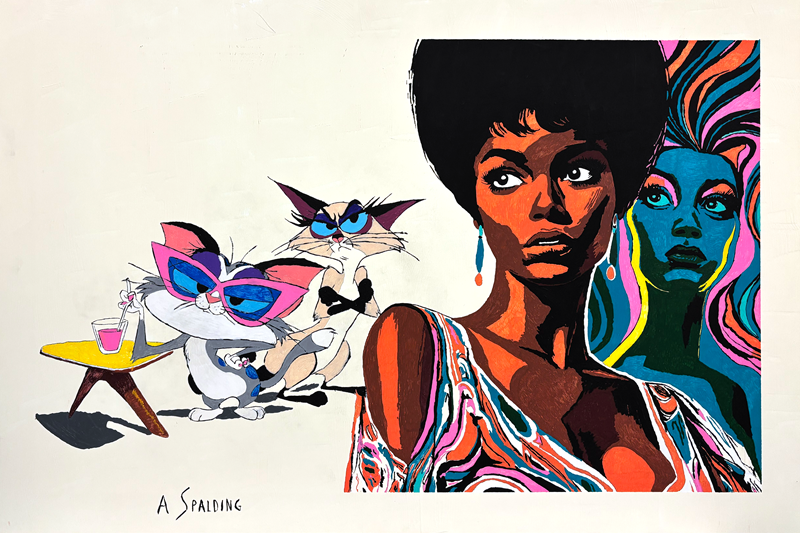
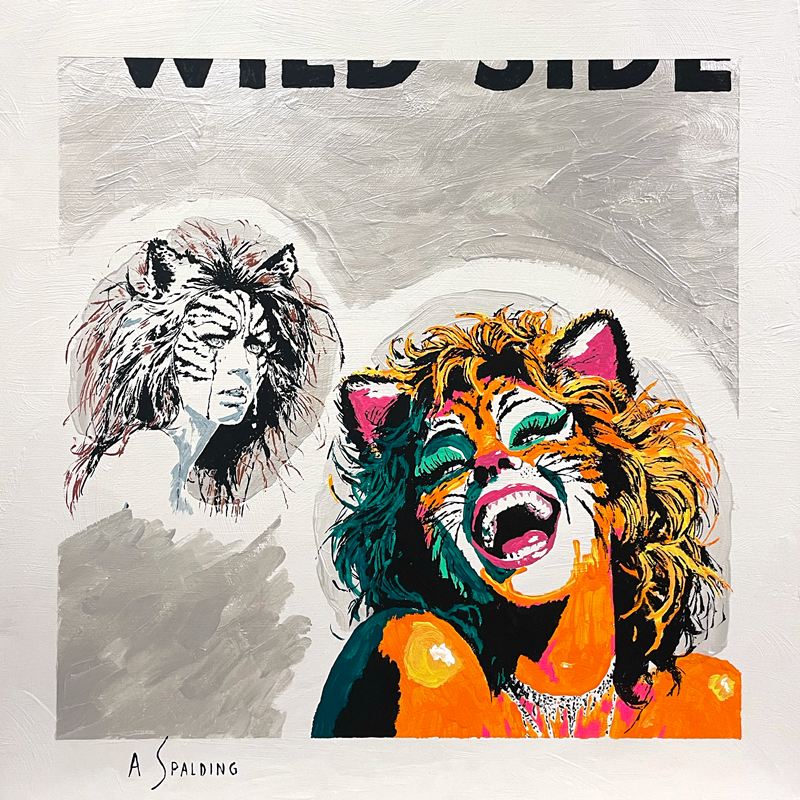
A. I paint in a loose, unrestrained, expressive way, and I enjoy strong contrast between light and dark: deep black, bright white, and vivid, energetic color.
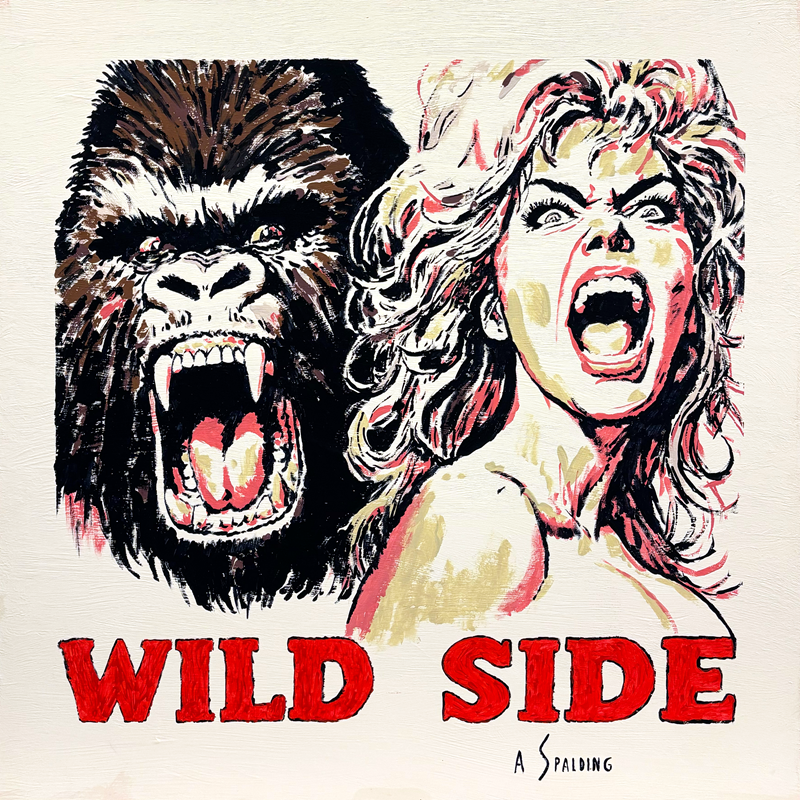
I create portraits of women and wild animals. Most of my work exists within a single series called “Wild Side”. The series has its own internal engine. The work itself motivates and directs me, growing through me. When it’s working well, I’m not planning or analyzing, and I feel less like a creator and more like a conduit.
Beneath the surface, I pour myself into every painting. Even though I am not a woman, the female figures are reflections of my own life and inner world, as well as representations of “the other,” the many people I have known, encountered, and been shaped or wounded by. The series has become a meditation on how we are all connected. Through figures and faces, I’m able to dissolve boundaries and points of pain between people, or between fragmented parts of myself.
The wild animals represent the danger that exists there, along with our bonds and separations from the world around us. They’re projections of my psyche, or of the psyches of women. The work is complex and charged, like a field filled with both beauty and hidden threats, yet I try to keep it feeling light, immediate, and playful on the surface.
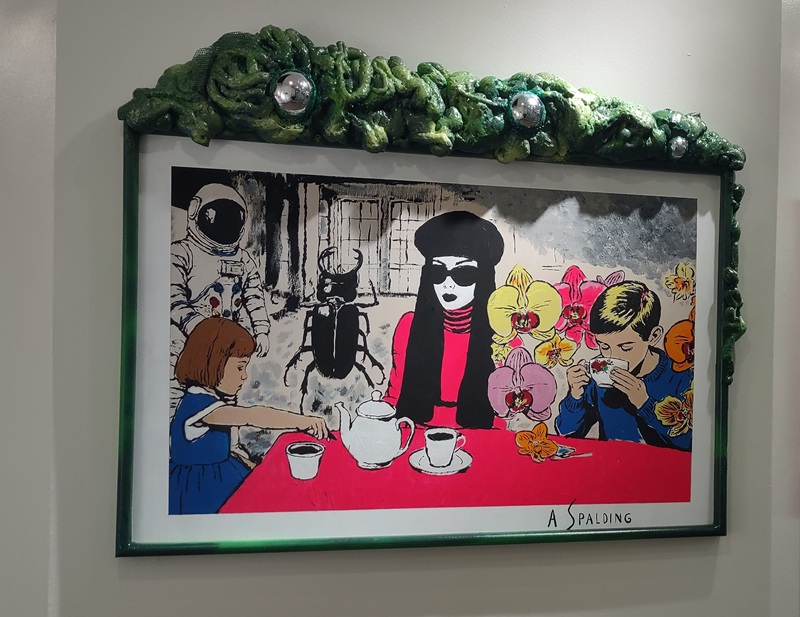
All my art is intended to be visually striking, emotionally engaging, and enjoyable. Collectors and artists often describe it as having a graphic, Pop Art-like appeal, and many feel it recalls album covers and rock posters. The paintings are designed to grab attention magnetically. I love seeing people notice them from across a room and become pulled toward them!
Q. Do you have any habits or routines that help you get into a creative flow?
A. I always brew coffee and set everything up so I can simply start painting. Sometimes I like to work in silence, but other times I put movies on in the background and find I enjoy that a lot.
It doesn’t take much for me to enter a creative flow, I’m always already partly lost in my imaginative space.
Q. How do you know when a piece is finished?
I have a working method designed to prevent overworking a piece. I’m very sensitive to the problem of losing the wind or life in a work of art, there’s almost nothing worse than that. I can feel it when it’s happening, but it’s so hard to stop if you don’t make rules or set up mechanisms to prevent it.
I would rather look at unfinished work than work that has been pushed to perfection. I choose movement and momentum over stiffness, even if something feels slightly wrong or unresolved. Because of this, I decide in advance which elements will be part of a piece. I allow each element to take up the space it needs within the composition, and then I build the work in stages.
The final things I add, before signing, are broad sweeps of black wherever I see a lack of gesture or energy.
If I step back and it looks finished, then it is finished, and I move on. If my signature is on it, it is absolutely done.
Q. Is there a recurring theme or symbol that keeps reappearing in your work, even when you don’t plan it?
A. Yes, many do. I’m deeply interested in symbolism and thematic art. “Wild Side” was originally built around an expandable theme: bringing the animalistic aspects and hidden fantasies of the inner world into the open.
It’s a psychological body of work, and I think it may function as a bridge between two different understandings of alienation. On one side are the ideas of R.D. Laing and existentialist writers, and on the other, contemplative mysticism. That bridging has been important to me as I try to navigate the world’s increasing demand to satisfy its perception of authenticity, which I don’t believe is fully possible. We are all misunderstood, negotiated into simplified, digestible categories that were never shaped to fit real human beings.
Many of the symbols I had been using unconsciously in my paintings, and in earlier years through music, rose to the surface while I wrote my last book.
The idea of a wilderness or wasteland is one of the clearest examples. I come from a wasteland, both literally and psycho-socially, places marked by deprivation and trauma. My figures tend to exist in voids, which may reflect both the sense of separation and the sense of freedom I feel when I’m removed from context and climbing toward my goals.
The Moon is another symbol that began to clarify itself for me during that time. The Moon exists in stark contrast against the dark field of the night sky, and lunar imagery connects me strongly to women.
I admire painters who work in daylight, capturing the constantly shifting colors of the world, but my own work is more attuned to interior spaces, settings that are dimly lit, yet ideal for reflection and contrast. Once I could consciously recognize the Moon as a symbol, it began to shape my process more intentionally. Despite the flatness of white space in my work, I started embedding deep scars and craters beneath their surfaces. Figures are now as I recognize myself, like the dark side of the Moon, or its shadow.
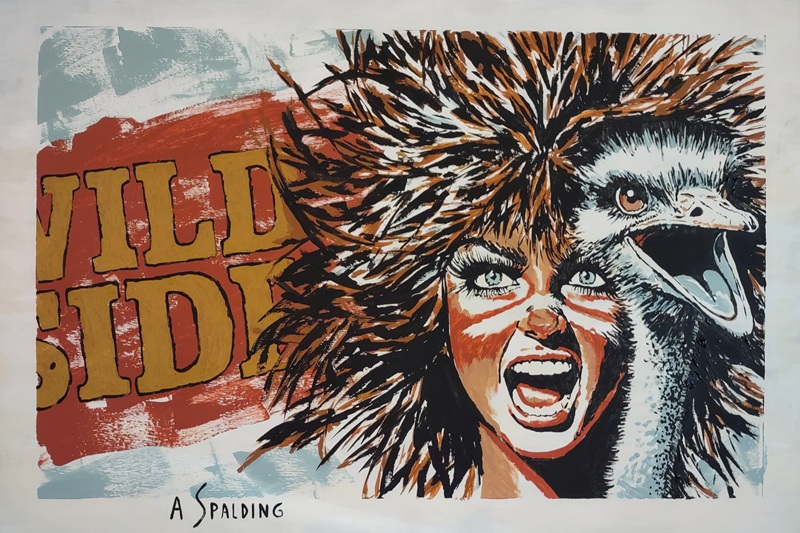
“Linda”- Studio artwork by Alex Spalding.
Q. How has your creative community (online or offline) shaped your evolution as an artist?
A. I wouldn’t be able to do much of anything without the other artists in my community. There are several who come to mind immediately.
Alyse C. Bernstein is an excellent printmaker who creates stunning lithographs of wild animals with rich, beautiful animal textures. Through a local Philadelphia arts organization called InLiquid, she helped me build my resume from the ground up, getting me to apply for shows and helping me find opportunities when I first started working in the visual arts. We still talk all the time about things happening in the city and ways to get involved.
I also discovered an artist whose work feels aligned with mine, Tulia Day. She does gorgeous oil paintings of women in a fantastical realism style that completely blew me away when I first saw them. I love her work and her color choices. We became collaborators; she helps me prep panels now because I don’t really have a studio. She’s essentially why I am able to keep making art.
If you come to one of my currently running shows, Soft Animals at Park Towne Place in Philadelphia, you’ll immediately notice several pieces with breathtaking, colorful, whimsical frames. They are all by another fantastic artist, Lindsay Kovnat Davis, whom I also met through our shared subject matter. Her work is incredibly vibrant and fun, and explores women and their relationships with these colorful, impish cats. In fact, later this year in October, I’m curating a show for Lindsay, Tulia, and myself at Kiosk Gallery in Lansdowne, PA. The show will be titled Feral Form Fantasies, which really describes each of our works.
Alison Mustikoff is another artist who makes lovely, voluptuous sculptures. She gave me my first solo show at her gallery, The Jane Gallery. One of her assistants, Jo Gamel, is another artist whose work I love, and she’s been a great champion for my art. There’s an artist Jill Hackney, out in Pittsburgh, she’s so great and always encourages me, and her work is just incredible, the rich colors of the landscapes she paints. The artist Alaina Joy helped me arrange this interview, and I love her work too; it’s got this awesome, bold street art style and advocates for feminine autonomy. I’m curating a show for her work also at FaceClock Gallery, which will be coming up in April. It’s titled Venom & Velvet!
There are many others as well, I could go on and on. I don’t know how I’ve found myself in such a fortunate position, knowing and working with so many brilliant and creative artists. All I can do is be grateful!
Q. How do you balance the personal meaning of your art with how others interpret it?
A. I try not to concern myself with how other people interpret my work. Instead, I focus on deepening my connection to what I’m making, enriching it, and refining my process so that everything can flow more freely.
I’m grateful when people feel moved to share their thoughts with me, and I love discovering points of connection and resonance with others through the work as a shared medium.
Q. What message, mood, or memory do you hope your art leaves behind?
A. I can’t control any of that, but I would be happy if my work guided those who encounter it toward greater love and respect for women and wildlife.
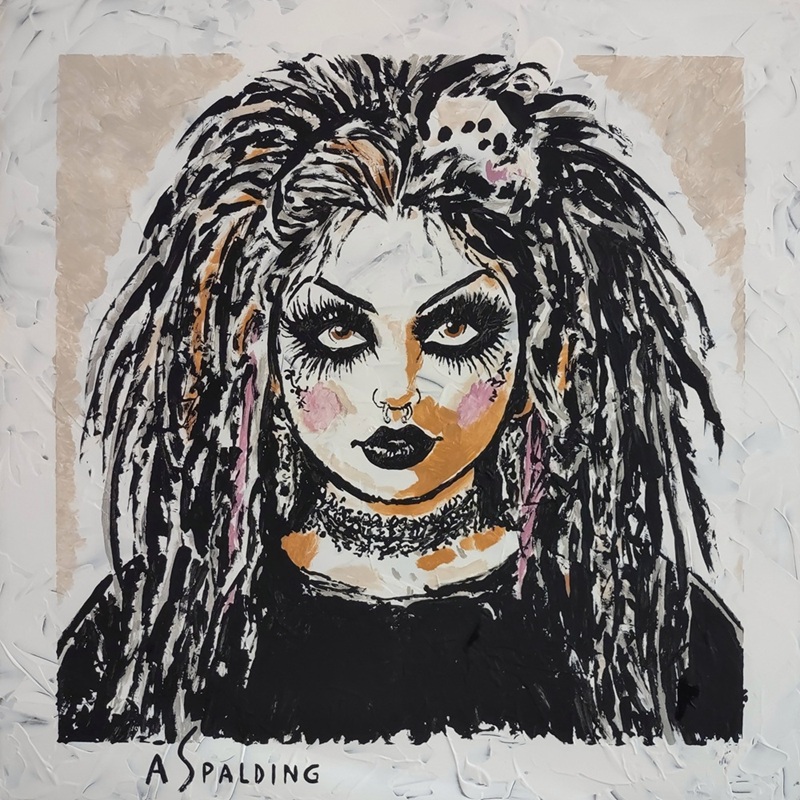
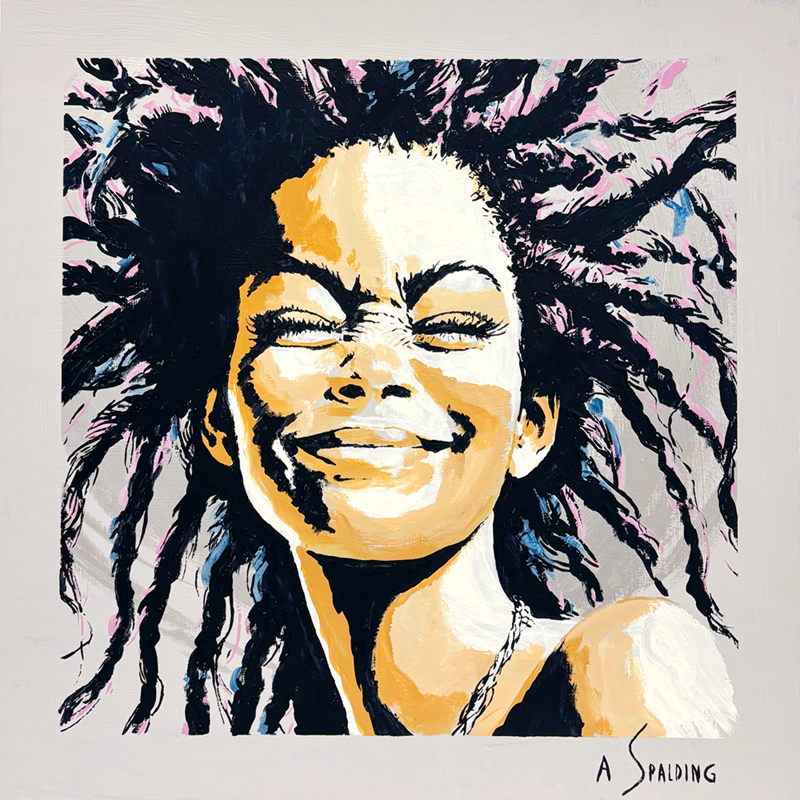
Studio artwork by Alex Spalding.
Listen in as Alex and I talk about being in the creative vortex, trusting moments of knowing, and the long-term dedication behind a creative life. The full Exchange below.
Ask Forward, Receive Back
A tradition inside The Exchange: each artist leaves a question for the next, creating an unbroken chain of curiosity, reflection, and creative lineage.
Johnny Degiorgio’s Question → For Alex
“What is a skill or medium that you haven’t tried for whatever reason, that you would like to dive into, and what would you like to create with it?”
Alex’s Answer
There are so many skills and mediums I want to dive into! I love airbrush and the kinds of effects artists can achieve with it. I tried using one once, and it made me nervous, so I know I need to try again.
If I can get comfortable handling it, I’d love to start combining illustrative, photorealistic elements with expressive and graphic stylistic elements and see where that leads.
In fact, I’ve decided now that I’m going to do that, so thank you for asking the question!
Follow along to see what Alex asks the next artist as this chain of creative curiosity continues.
Thank you to Alex for sharing his time, words, and world.
You can find more of his work on Instagram @aspaldingart
Website; https://www.aspaldingart.com/
Email: info@aspalding.com
Stay tuned for the next installment of The Exchange — more artists, more conversations, more creative fuel.
Discover more from Please Hold Studio: Characters & art by Alla K • NYC
Subscribe to get the latest posts sent to your email.
wish you best and best