
The Exchange: Alaina Joy — Art as Resistance, Bodies as Voices
For this Exchange, I sat down with Alaina, an artist whose work is fearless, deeply felt, and rooted in the lived experience of being in a body. Her art centers the female form as something powerful and expressive- not polished or passive, but emotional, loud, imperfect, and real. Through bold color, hand-painted paste-ups, and work placed intentionally in public spaces, Alaina uses art as a way to speak up, take up space, and push back.
We talk about growing up surrounded by making, losing touch with creativity and finding it again, and how her practice has slowly shifted from personal exploration into something more public and community-driven. From dream-born imagery to wheat paste and street work, this conversation traces how instinct, care, and honesty shape her process. Alaina’s work doesn’t try to soften its message- it shows up exactly as it is, and invites you to do the same.
Q. What would you say was your gateway creative outlet?
A. My gateway creative outlet was honestly just growing up surrounded by making things. Art has been part of my life for as long as I can remember. Some of my earliest memories are sitting at the table with my mom, painting, gluing, cutting, turning everyday moments into little crafts. I was that kid who was obsessed with stickers—collecting them, trading them, saving them like tiny treasures because they felt like art you could hold onto. Creativity was never something I had to “find”; it was always there, woven into how I moved through the world.
Like a lot of people, life got busy and that creative spark went quiet for a while—until COVID hit. Everything slowed down, and in that stillness I found my way back to creating. Around the same time, I fell in love with crystals, and that curiosity turned into making crystal jewelry by hand. That small, grounding practice opened a door I didn’t even realize I needed. Making jewelry led me to craft markets, and craft markets led me back to painting—back to trusting my instincts, my hands, and my voice.
Painting and showing my work introduced me to an entirely new creative world: stickers, street art, community, and connection. Suddenly, those stickers I loved as a kid made sense again, but now as a form of self-expression and storytelling. Looking back, it all feels very full-circle. My gateway wasn’t one single moment—it was a lifetime of creating, pausing, and returning, each time with a little more honesty and heart.
Q. How would you describe what you create to someone who’s never seen your work?
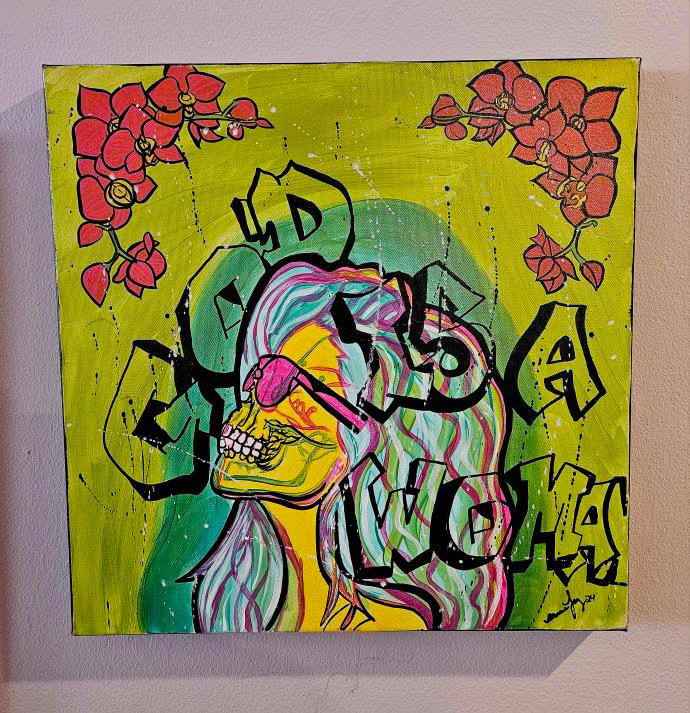
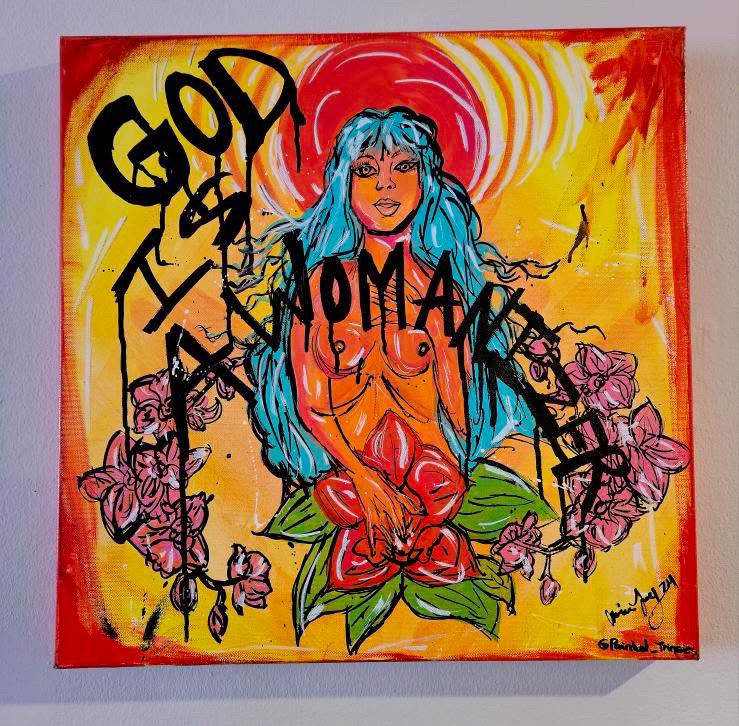
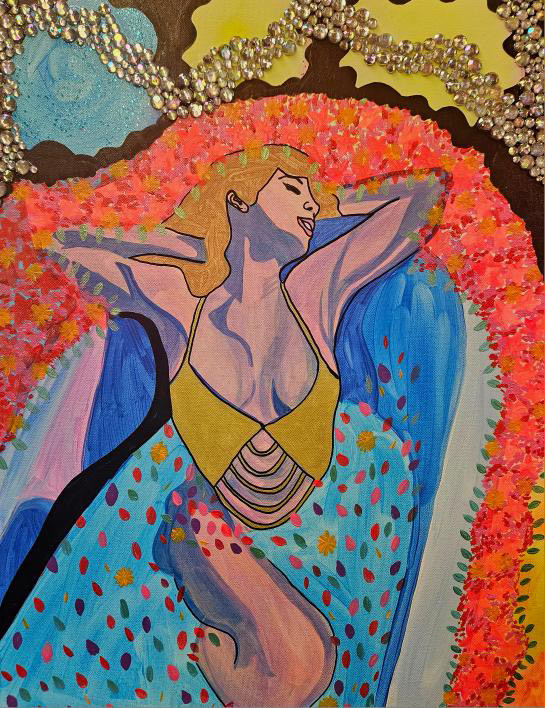
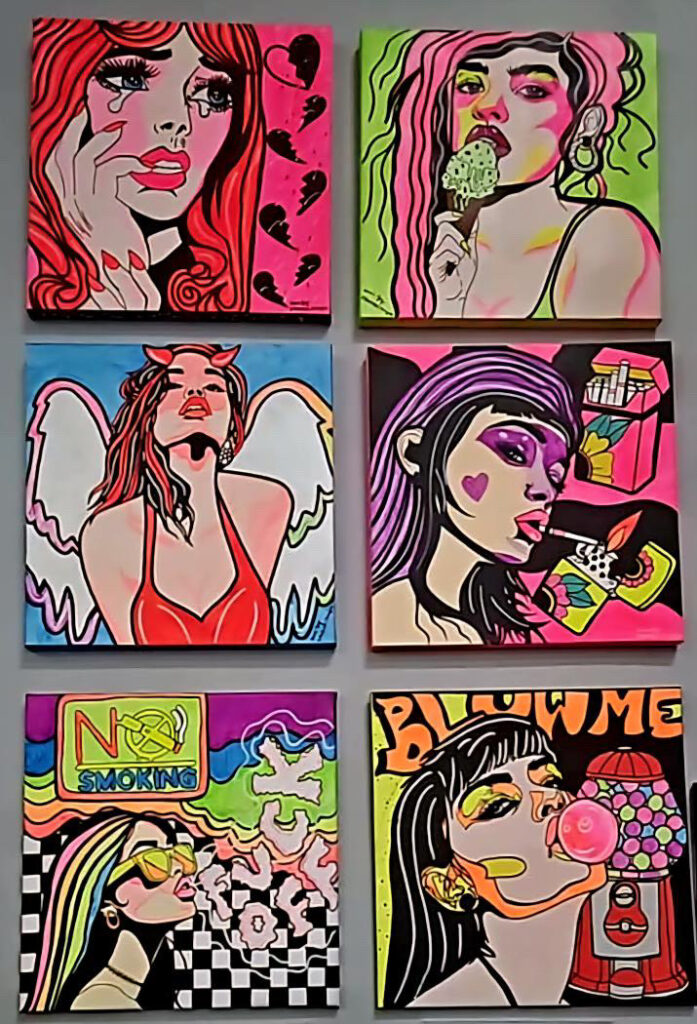
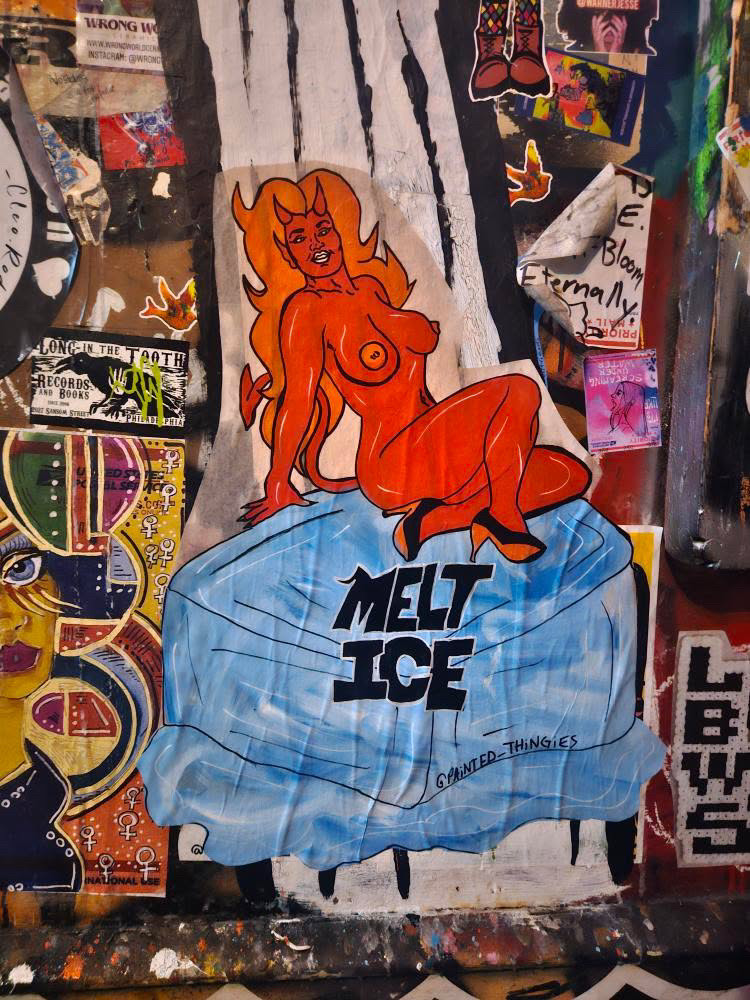
A. I create bold, confrontational art that puts the female body back where it belongs—at the center of its own story. My work uses saturated color, graphic elements, and mixed media to depict bodies that are loud, imperfect, emotional, and unapologetically real. These figures aren’t decorative or passive; they’re political. They exist as statements of autonomy, resistance, softness, rage, and self-ownership.
At its core, my work is about reclaiming the body from systems that try to shame, censor, control, or commodify it. I reject the male gaze and instead frame femininity on women’s own terms—messy, powerful, tender, furious, and human. Themes like bodily autonomy, consent, reproductive justice, and fundamental human rights are woven throughout everything I make. If you’ve never seen my work, I’d say this: it’s art that doesn’t ask for permission. Each piece is both a declaration and a confrontation—an insistence that women’s bodies are not objects or debates, but lived realities worth defending loudly. My goal is for people, especially women, to feel seen, empowered, and unashamed—to recognize their bodies as voices, not something to be controlled or explained away.
Q. What materials or tools do you feel most connected to right now?
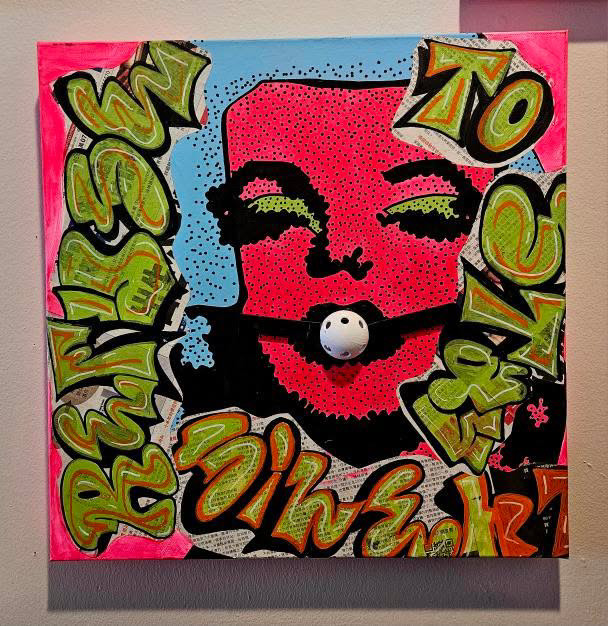
A. Right now, I feel most connected to materials that let me work with my hands in a really physical, intuitive way—things that feel rooted in street art and community rather than polish or perfection. Wheat paste is a big one for me, especially my mom’s paste, Concrete That Sh*t by @must_get_sconed. I genuinely believe it’s the best wheat paste out there because it’s made by an artist, for artists. It’s strong, reliable, shelf-stable, organic, vegan, and safe to have around kids and pets, which really matters to me. I love that it’s something I can keep in my studio without worry, and it just works—no fuss, no frustration. Supporting other artisans, especially ones in my own orbit, feels just as important as the art itself. Using artist-made products keeps the cycle of care and creativity going. I’m also really drawn to using wall paint instead of acrylics. There’s something about it that feels more honest and more aligned with where my work lives. It’s meant for surfaces, meant to last, meant to take up space. It connects my studio practice directly to the street, which feels right for the kind of work I make. I deeply love hand-painting my paste-ups instead of printing them. Every brushstroke, every imperfection, every decision is intentional and embodied. You can feel the time, the emotion, the human behind it. For me, that matters more than clean edges or perfect repetition. I want the work to feel alive—like it came from a body, not a machine. Overall, I’m most connected to tools and materials that reflect my values: handmade, community-driven, tactile, and unapologetically human.
Q. Is there a piece or project that changed how you see yourself as an artist?
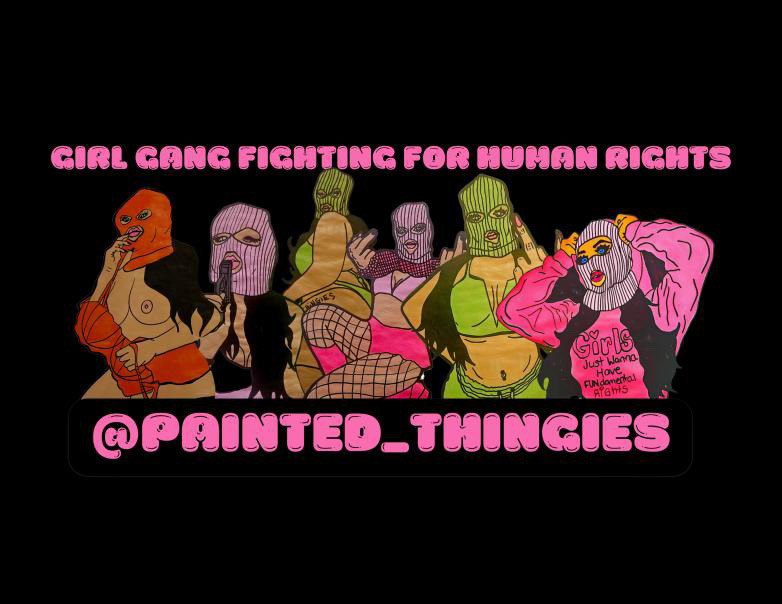
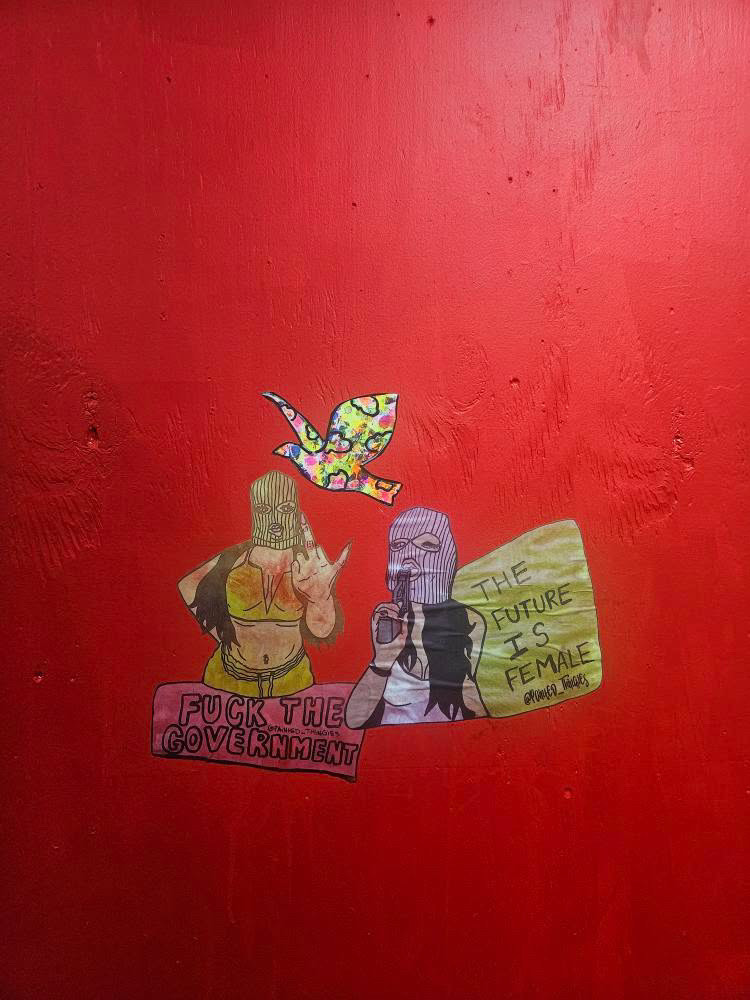
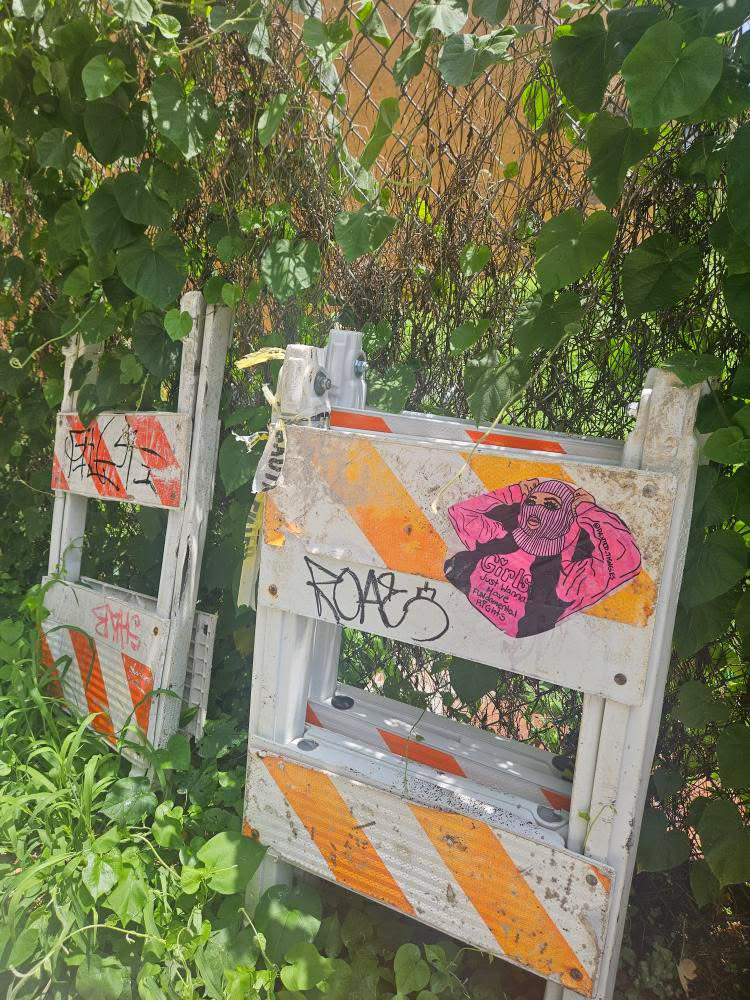
Yes—”Girl Gang Fighting For Human Rights” fundamentally changed how I see myself as an artist, and it did so because of what the project was really responding to. That series was born directly out of anger, fear, and defiance in the face of a government that feels entitled to police, legislate, and control female bodies. It was my response to watching bodily autonomy be treated like a political bargaining chip instead of a fundamental human right. The masked figures represent both protection and solidarity—women having to armor themselves just to exist safely, while still standing together, visible, and unafraid. There’s anonymity in the masks, but also power: this isn’t about one woman, it’s about all of us.
Putting “Girl Gang Fighting For Human Rights” into the street was intentional. These weren’t images meant to live quietly in a studio or politely on a wall—they needed to be public, unavoidable, and impossible to ignore, just like the reality of what’s happening. Pasting them up felt like reclaiming space in a world where women are constantly told to shrink, comply, and accept less control over their own bodies. The message is simple but non-negotiable: bodily autonomy is a human right, and freedom of choice should never be up for debate. That project forced me to fully claim my voice as a political artist. It made me realize that my work isn’t just about representation—it’s about resistance. About refusing to normalize control, shame, or silence.
Seeing those pieces exist in public space showed me that my art could function as protest, as visibility, and as collective affirmation for anyone who feels their rights are being stripped away. After that project, I stopped questioning whether my work was “too loud” or “too confrontational.” I understood that taking up space—especially in the streets—is part of the message itself. “Girl Gang Fighting For Human Rights” taught me that my role as an artist is not to be palatable, but to be honest, to be visible, and to stand firmly in defense of bodily autonomy and freedom of choice.
Q. When do ideas come to you — slowly over time, or in quick bursts?
A. Ideas usually arrive to me in quick, vivid bursts, but they don’t feel rushed—they feel revealed.
Most of my work begins in dreams or in that half-awake liminal space where logic loosens its grip. I’ll see an image fully formed or almost fully formed—symbolic, charged, emotionally loud. It’s rarely a concept first; it’s ideal imagery. A body, a pose, a color, a tension. That image becomes the anchor, and everything else slowly gathers around it like gravity doing its job.
After that initial flash, the process becomes slower and more deliberate. I sit with the image. I let it haunt me. I ask why it showed up, what it’s responding to—politically, emotionally, viscerally. The meaning sharpens over time, but the core always comes from that instant of recognition, that feeling of oh—there you are.
So the spark is sudden, almost intrusive, but the evolution is patient. My art lives in that in-between space—between dreams and waking, instinct and intention—where the subconscious speaks first and I spend the rest of the time listening and translating.
Q. How has your practice evolved, and where do you see it heading?
A. My practice has grown in both depth and intent over time. Early on, I was drawn to the immediacy of mark-making—sketching, drawing, painting—especially the female form as an expression of identity, strength, vulnerability, and autonomy. That fascination wasn’t just aesthetic; it was personal, a way to explore and honor lived experience. Over time, it has become more than just drawing bodies—it has become about what those bodies represent: agency, resilience, and the power to claim space.
As my work evolved, the focus shifted from personal exploration to public advocacy. Themes of women’s rights, bodily autonomy, and gender equality began to surface more prominently through everything I create and curate. It’s not just about depicting figures anymore—it’s about what those figures say and do. Participation in projects like The Vote Project by @she.posse , where art became a tool to inspire civic engagement and raise awareness on issues like bodily autonomy and gender equality, was a meaningful turning point.
I’ve always loved vibrant, expressive imagery, and I still return to drawing and painting because it’s the truest way for me to feel into an idea before anything else. But now that imagery isn’t held in isolation—it’s woven into community programs, public murals, exhibitions, and collaborative spaces that uplift others alongside my own voice.
Looking ahead, I see my practice becoming even more intersectional and community-rooted. I want to continue centering women’s voices, particularly those at the margins, and expanding how and where art happens—outside gallery walls, in public spaces, and in shared experiences that invite people in rather than keeping them out. I want to keep pushing the conversation, not just visually but socially, using art as activism to challenge norms, spark dialogue, and celebrate autonomy in all its forms.
Q. What’s your studio or workspace vibe — quiet, chaotic, ritualistic, spontaneous?
A. My workspace is chaotic, intuitive, and deeply alive—basically a physical manifestation of my ADHD brain. There’s no pristine, minimalist studio fantasy happening here. It’s piles of reference images, half-finished sketches, paint-stained everything, objects I swear I’ll need later, and materials gathered with zero explanation other than “this felt important at the time.”
I joke that I’m an art raccoon—or a trash panda—because I collect things instinctively. Scraps, textures, found objects, old prints, weird ephemera… if it has potential, it ends up in my orbit. That chaos isn’t accidental; it’s where my ideas live. I need to see everything at once for my brain to make connections, even if it looks unhinged to anyone else.
There’s a spontaneous rhythm to it. I move between drawing, painting, rearranging, abandoning something, and coming back to it days later. It’s messy, but it’s honest. The disorder gives me permission to experiment without overthinking, which is essential to how I work.
So while it might look chaotic, it’s actually functional chaos—controlled entropy. It mirrors how I create: fast, intuitive, emotionally driven. The studio doesn’t calm my brain; it keeps up with it, and honestly, I wouldn’t have it any other way.
Q. Do you have any habits or routines that help you get into a creative flow?
A. For me, creative flow is all about intention and environment. I don’t really believe in forcing it—I set the stage and let it happen. Smoking cannabis helps quiet the mental noise and loosen the grip of overthinking, which lets ideas surface more intuitively. Pair that with the right music—something that hits emotionally or hypnotically—and my brain clicks into a different frequency.
I’m also very ritualistic about my workspace. I need everything laid out and within reach: paints, brushes, references, half-finished ideas, chaos organized just enough to feel safe. Taking the time to set up my station signals to my brain that it’s time to create. When I’m in the right headspace—grounded, open, a little feral—that combination makes all the difference. That’s when the work starts to pour out instead of being pulled.
Q. What part of the process do you love most — and which part do you wrestle with?
A. The part of the process I love most is the moment when something finally clicks—when the concept, the emotion, and the visual language line up and the work starts to feel inevitable. That’s the sweet spot where instinct takes over, and I’m no longer questioning every mark. It feels honest, cathartic, and a little feral, like I’m channeling something instead of inventing it.
The part I wrestle with most lives on the other side of that: the beginning and the pauses. Creative block and imposter syndrome creep in hard when the work isn’t flowing yet—when the canvas is blank or when I step back and start asking myself if what I’m making is “good enough,” loud enough, or worthy of being seen. There are moments where I feel like I’m pretending to be an artist instead of being one, even after years of proof to the contrary.
But I’ve learned that those feelings are part of the process too. The doubt usually shows up right before something honest breaks through. Wrestling with it is uncomfortable, but it’s also where the work sharpens its teeth. I’ve come to trust that if I stay in it long enough, the block will crack—and when it does, the work that comes out is almost always more raw, more intentional, and more me.
Q. How do you know when a piece is finished?
A. I know a piece is finished when it stops asking me for more. There’s a point where any additional mark feels like noise instead of intention—where pushing it further would be about my anxiety or perfectionism, not the work itself. When I can step back and feel a quiet sense of this is what it needed, that’s usually the sign.
A lot of that comes from learning to trust my instincts, especially after wrestling with imposter syndrome. I’ve had to unlearn the urge to overwork a piece just to prove something—to myself or anyone else. When the emotion lands, the message is clear, and the piece holds its own without me explaining it, I let it be. Finished, for me, doesn’t mean perfect. It means honest, resolved, and alive enough to stand on its own without me hovering over it.
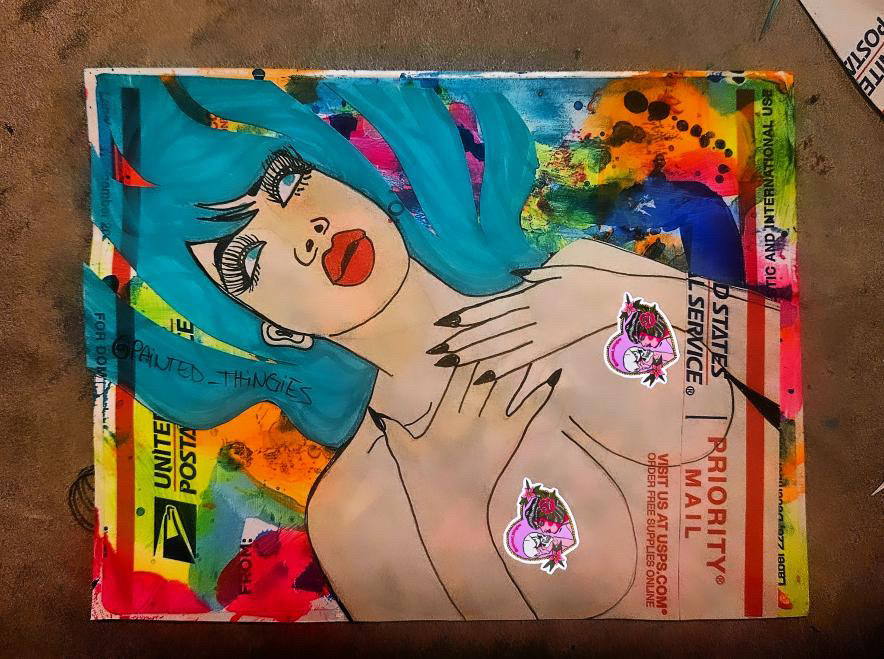
228 sticker collab with @mizchaos
Q. Is there a recurring theme or symbol that keeps reappearing in your work, even when you don’t plan it?
A. Absolutely. Even when I don’t set out with a specific symbol in mind, the female body keeps reappearing in my work—fragmented, exaggerated, confrontational, unapologetic. It shows up as a site of power, tension, and resistance rather than something passive or ornamental. I’ll often find myself returning to breasts, hips, mouths, hands—parts that have historically been policed, sexualized, or censored—and using them deliberately, almost defiantly.
There’s also a recurring sense of contrast that sneaks in: softness paired with danger, beauty tangled with discomfort, desire sitting right next to rage. Saturated color, bold outlines, and pin-up or pop-culture references surface again and again, even when I’m not consciously reaching for them. I think those repetitions come from instinct more than planning—they’re the visual language my body knows. No matter the subject, the work keeps circling back to autonomy, reclamation, and the act of taking up space without apology.
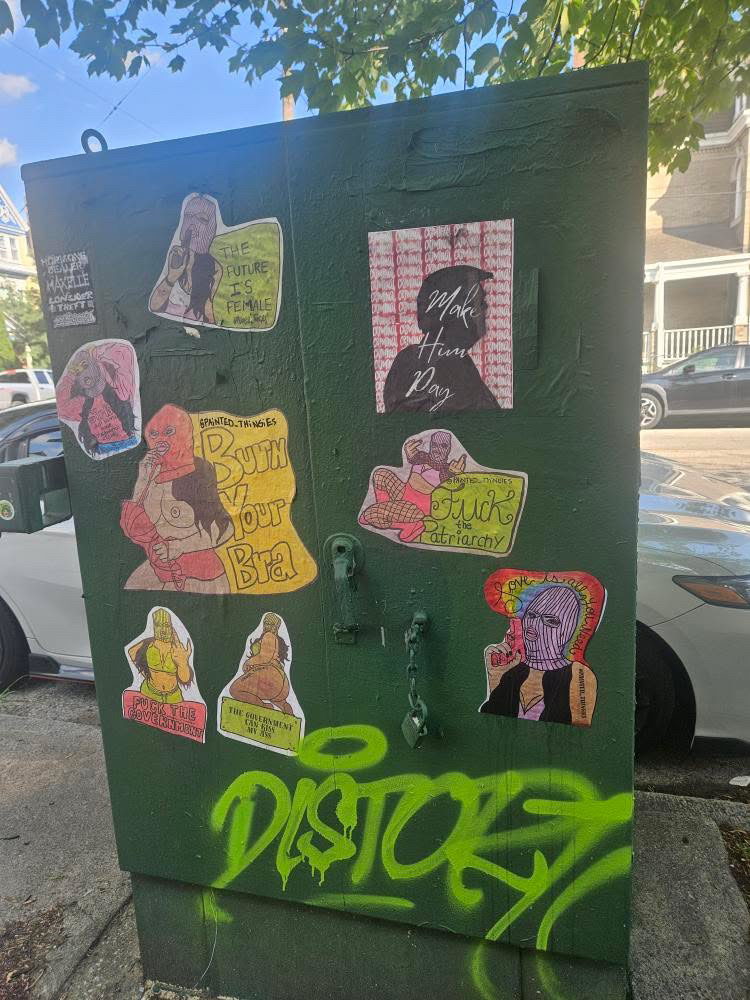
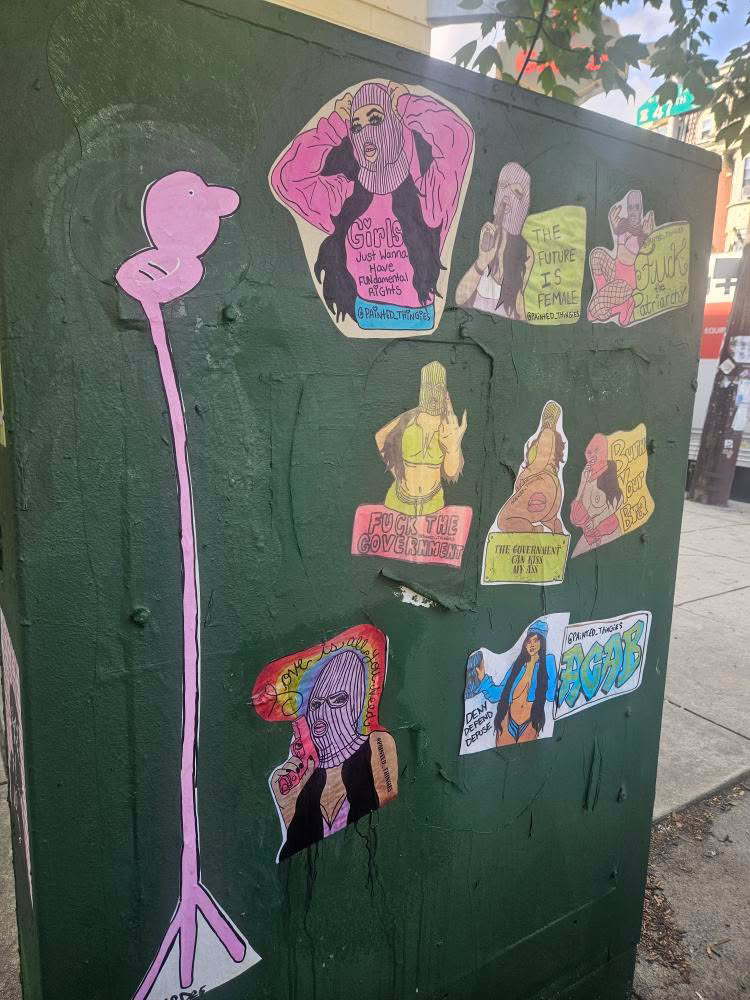
Street art by Alina and @birdthetallestone
Listen in as Alaina Joy and I talk about, pausing, returning to art, and trusting the timing of creativity- the full Exchange below.
Ask Forward, Receive Back
A tradition inside The Exchange: each artist leaves a question for the next, creating an unbroken chain of curiosity, reflection, and creative lineage.
Kiri Theory’s Question → For Alaina Joy
“Who inspired you to purse creativity, and what was it they did that was most effective for you? Was it a mentor, another creative, or someone/ something else entirely?”
Alaina’s Answer
For me, creativity was never a single lightning-bolt moment or one person who “gave permission” — it was something that was quietly and consistently nurtured, protected, and encouraged by the people around me.
It starts with my mom. From a really young age, she made creativity feel normal, necessary, and worth making space for. Art wasn’t treated like a hobby I’d grow out of — it was something I was allowed to explore freely, mess up, return to, and trust. She never told me who I had to be creatively, just that I could be. That kind of early validation sticks with you. It taught me that making things wasn’t frivolous — it was a way of understanding myself and the world.
Then there’s my husband, Joe Rabcow of @discarded.radioshack.project. Being partnered with another artist who genuinely gets it has been transformative. Joe’s support is endless — not just in words, but in action. He believes in my work even on the days I don’t, pushes me to take risks, and reminds me that experimentation, failure, and evolution are part of the process. Watching how his mind works, how he builds worlds from discarded tech and static, constantly inspires me to stay curious and unapologetic in my own practice.
I’m also deeply inspired by my art sisters — the women and nonbinary creatives in my life who show up, hold space, hype each other up, and create without asking permission. Their support is grounding and affirming. Seeing them carve out space in a world that often tries to shrink us fuels me in ways that are hard to put into words.
And honestly? I’m inspired daily by my fellow artists — locally, online, in the streets, in studios, in abandoned buildings, on walls, on canvas, in mediums that defy definition. Watching people create in spite of capitalism, censorship, burnout, and fear reminds me why I do this. Their work challenges me, comforts me, and pushes me to keep going.
If there’s a common thread, it’s this: the people who inspired me most didn’t tell me what to create — they made me feel safe, supported, and encouraged enough to keep creating. And that’s everything.
Follow along to see what Alaina Joy asks the next artist as this chain of creative curiosity continues.
Thank you to Alaina Joy for sharing her time, words, and world.
You can find more of her work on Instagram @painted_thingies
Stay tuned for the next installment of The Exchange — more artists, more conversations, more creative fuel.
Discover more from Please Hold Studio: Characters & art by Alla K • NYC
Subscribe to get the latest posts sent to your email.